
ABOUT ME
and in particular Corkscrew Hill , Ist Prize National Poetry Competition 2014, and my writing in general
To read my poems only, go to the POEMS page.
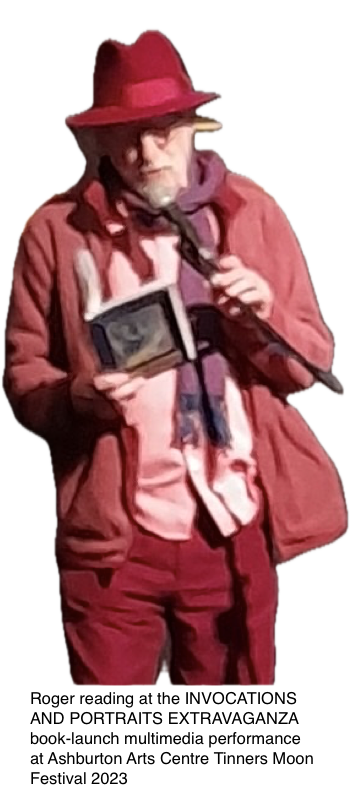
I STARTED TAKING MYSELF SERIOUSLY
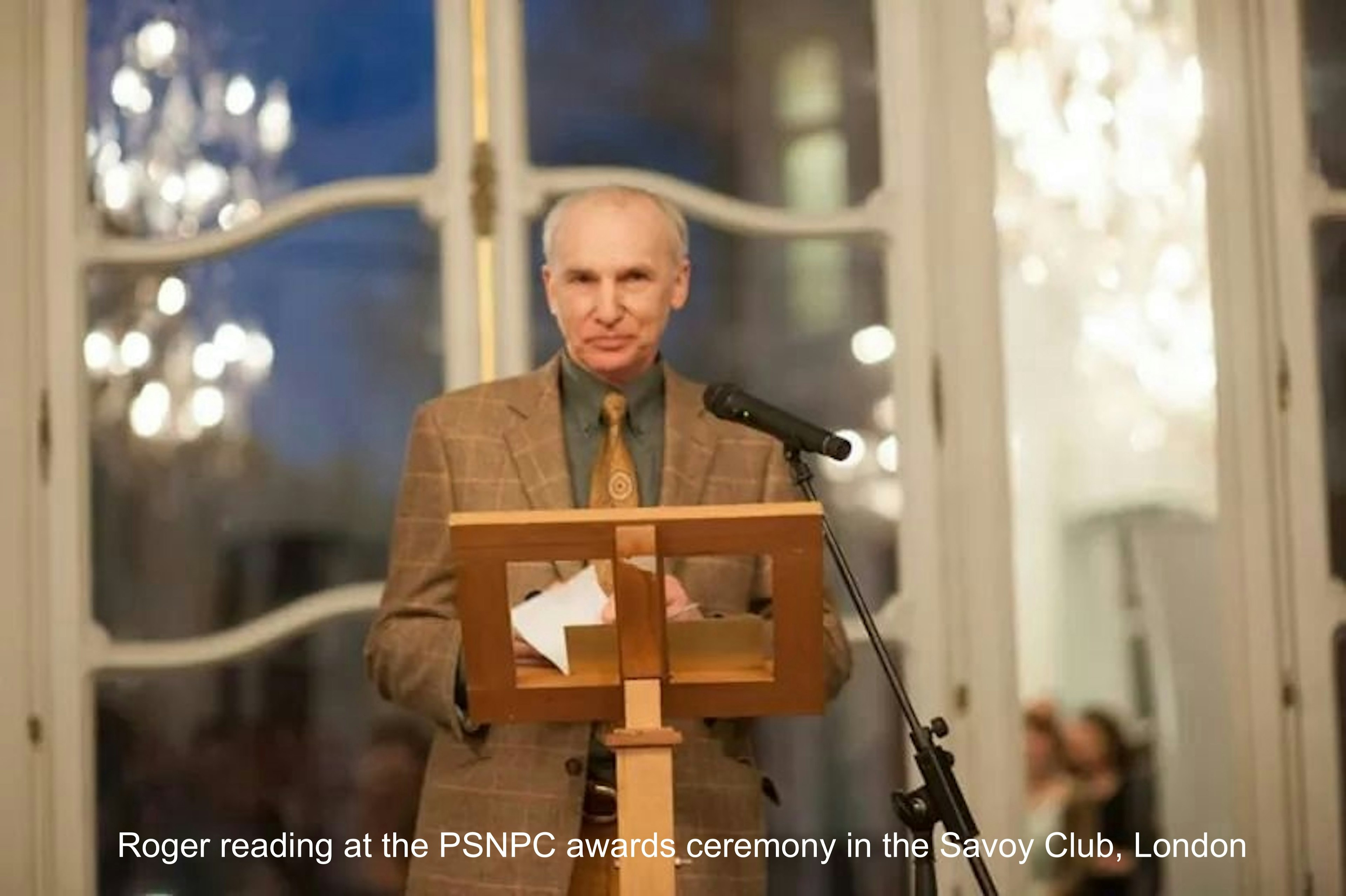
as a writer and poet when, having never entered any poetry competition before, let alone won one, I found myself being awarded the top prize in the Poetry Society National Poetry Competition 2014 for my poem, CORKSCREW HILL PHOTO
There were over 13,000 entries that year. My thanks go to the judges - Roddy Lumsden, Zoë Skoulding, & Glyn Maxwell - especially Roddy Lumsden, who said:
"Roger's winning poem is a stunning poem, which mixes sweetness, sentiment, the visual and a touch of the grotesque. It seemed to contain a strange mix of naivety and complexity. Most of all, I couldn't quite grasp what it was about, but in the best of ways - I wanted to reread and make my own story from what was being offered."
Roddy Lumsden, 1966-2020
You can hear me reading Corkscrew Hill Photo here in the excellent film-poem by James W Norton (commissioned by the Poetry Society):
Available also on the Poetry Society CORKSCREW HILL PHOTO page, and on Norton's site on Vimeo.
Corkscrew Hill Photo
All afternoon she counts the sounds
until the fly-specked room crackles with silence.
Even the song thrush noteless. A thick drizzle
trickles rivulets down the window pane,
smears distance on fields, curtains-off hills
and greens the sagged thatch,
aches in the creaking gate and screws
watering eye to misting glass:
a hearse skids slowly up the muddy lane
blurs in droplets on a spider-web
spins sideways into darkness….
….rattling cough of cattle, rusty tractor,
hinge of paint-peeled door, gears
of cars forced to back in one-track lanes,
buzz of pylons spanning the hum
of outboards in the yachtsmen’s creek,
yelp of kids in the converted Mill
the soft click-click of a camera-shutter
up Corkscrew Hill….
The casement steams with sunset. She picks herself
up off the floor, mouth dry as mourner’s grin.
Her arm reaches, shakes, reaches again
gathers the clattering jar from the shelf.
“Cider?”
The landlord frowns, sniffing cat,
moth-ball, mould. She squares her back
on his fine view – the duck bob,
seagull clutter, gape of lime kiln.
“And a nip of lovage,”
before he can point her
the off-licence hatch in the yard,
“to keep out the damp!”
and smiles spittle.
Her flagon scrapes a scroll of varnish
the length of the bar’s stripped pine
past bleating townies, past the regular’s chair
and the corner where the photographer
sits draining her valley
through a tilted lens.
Corkscrew Hill Photo is published in the Day and Dennis collaborative collection of paired poems, Invocations and Portraits [published by Wylde Publications 2023]
To read other poems by me, including ones that have been long-listed in major international poetry competitions, go to the POEMS page.
I HAVE BEEN ASKED, WHERE IS CORKSCREW HILL? IS IT INVENTED?
People have found similar named hills elsewhere, in Ireland for example, but my Corkscrew is in Devon. On the Dart estuary, between Tuckenhay and Cornworthy. I and my partner Nicole, and a friend, lived tucked (appropriately) under its slopes for a winter, after graduating from a Dartington College Arts course, back in 1982-3. Everything described in the poem was seen or heard at some time or other, apart from the cider-drinker picking herself up off the floor and scraping a scroll of polish off the riverside pub bar. Which remained, as fas as I can recall, in good and certainly very serviceable condition. And a few years later, it became a popular tourist attraction, on being acquired by TV celebrity chef Keith Floyd.
Who is the photographer? Well, that could be either of us, as we were both still taking black-and-white film photographs on Nikon and Pentax cameras, and developing them and the prints in the College dark rooms. We also worked on a tape-slide show (long before the days of digital presentations) featuring Tuckenhay, taking colour transparencies. And I was employed by the Tuckenhay Mill owner to do a series of line drawings of the mill and its cottages and other buildings that he was converting into holiday let accommodation, for his publicity. So a lot of observation of that very limited local area took place.
However, do not let these autobiographical details put you off James Norton's excellent film version, which gives an equally viable interpretation; indeed, a more creative, and in many ways preferable, one. No poem should be pinned down to any one interpretation.
MY WRITING BIOGRAPHY
When did I start writing? And have I always been doing it? (Both yes and no to that last question - read on.)
I was interested in writing and art-work since an early age. (See “About Me” in the Artworks section for more details of my art life.) Various drawings and a few poems found their way into school magazines.
That interest continued as a student at St Andrews University (1969-73). Which I went to interested in English Literature and History, but ended up, via detour BA qualifications in Fine Art, with a joint honours degree in Logic-&-Metaphysics with Moral Philosophy. To balance that, I co-founded, edited, and produced three editions of a Literary-Arts magazine, as well as contributing prose, poetry and line drawings to it. This annual publication we called Entry — a name chosen, not only to encourage a wide range of contributors, but also to indulge a tortured pun of “N-Tree”, standing for the Tree of Knowledge ( - as undergraduates will!)
Graduation left me over-saturated with words and concepts, and I abandoned them for a time to concentrate on art and craft activities (see the Artworks section for more details.) The poems continued to arrive, but simmered away on the ‘back-boiler’ and only occasionally saw the light of day with special friends.
I also started, as the ‘Seventies wore on, writing a prose novel. It was much of a roman de clef, with far too much ambition to emulate modernist avantgarde authors, and with not enough actual life experience to feature much in the way of attention-grabbing episodes.
Time passed, including at the end of 1979, the start of a two-year full time course in ‘Art and Design in a Social Context’ at Dartington College of Arts in Devon.
Not long after that, in 1984 I went on a cut-price Arvon Creative Writing course, where I met the writers (and co-founders of the Arvon) John Moat and John Fairfax. They were very encouraging about my prose writing, if less so about my poetry. So much so that they arranged an Arvon bursary for me for a years’s ‘Apprenticeship Scheme’ to work with the published novelist and writer Paddy Kitchen [biographies: Patrick Geddes (1975), Gerard Manley Hopkins (1978); novels: Lying-In (1965), A Fleshly School, Linsey-Woolsey, Paradise. A Pillar of Cloud (1979), The Golden Veil (1981), Blue Shoe (1988).]
That altered the form and quality of my novel considerably. However, it was still unfinished at the end of the year. It much impressed John Moat, who engaged me to help him with a re-edit of his novel The Tugen and the Toot. Which had suffered severe edits removing several episodes, imposed by his editors at Jonathan Cape. He now had the opportunity to issue a revised edition with Green Books [connected to the magazine Resurgence, to which John contributed the regular humorous column Didymus for many years.]
However, John got it into his head that what was needed was a new title to distinguish it from the earlier, incomplete publication. This was a shame, which he eventually, well after the event, also realised, because the Tugen is the distinguishing robe of an Irish bard, and the Toot, “a dialect term for a maiden’s breast,” often applied to topographical features, a word derived from Old High German tutta or tuta (nipple) and Old Norse tuta (a teat-like prominence), referring to any small, conical, or nipple-like elevation in the landscape. As titles go, that was hard to beat.
What was settled on, after numerous suggestions of mine were, quite rightly, rejected was The Missing Moon. Which does not really give any idea of what the book is about, or its mood, which, while seldom straying far from a witty and accomplished humour and satire, meanders around the serious nature of a writer’s artistic creativity, and all its difficulties.
I continued to work with John Moat for many years on occasional editing projects, and he became a writing mentor and good friend. And I was on good terms with his friend John Fairfax, who also influenced my work. Both Johns were highly accomplished poets writing contemporary poetry that yet was outside of the fashionable poetic forms and (often) contents. They are generally over-looked and much under-rated writers, whose book, The Way to Write, (1981,) endorsed with a foreword by Ted Hughes, was outstanding in its day and still serves as a an excellent first choice for any would-be writer.
My novel, Waiting for Miranda, continued to be refined over the years, responding to encouraging comments included with firm declinations from publishers and agents. It now resides in the drawer, waiting, as in its title, for a favourable moment.
Poetry is now my dominant writing interest, and new work continues to arrive, if not every day, in regular quantity. That, and taking an active role in Wylde Publications and its associated events, such as the recent (2026) The Winding Stair poetry-play book by Steve Day, its performance publicity, and an accompanying art exhibition that I curated.

BETWEEN NEW YEAR AND OLD £10 + post and packaging